
Is your Brighton holiday let compliant? Discover your legal duties regarding holiday home PAT testing to ensure guest safety, meet insurance requirements, and protect your short-term let business.
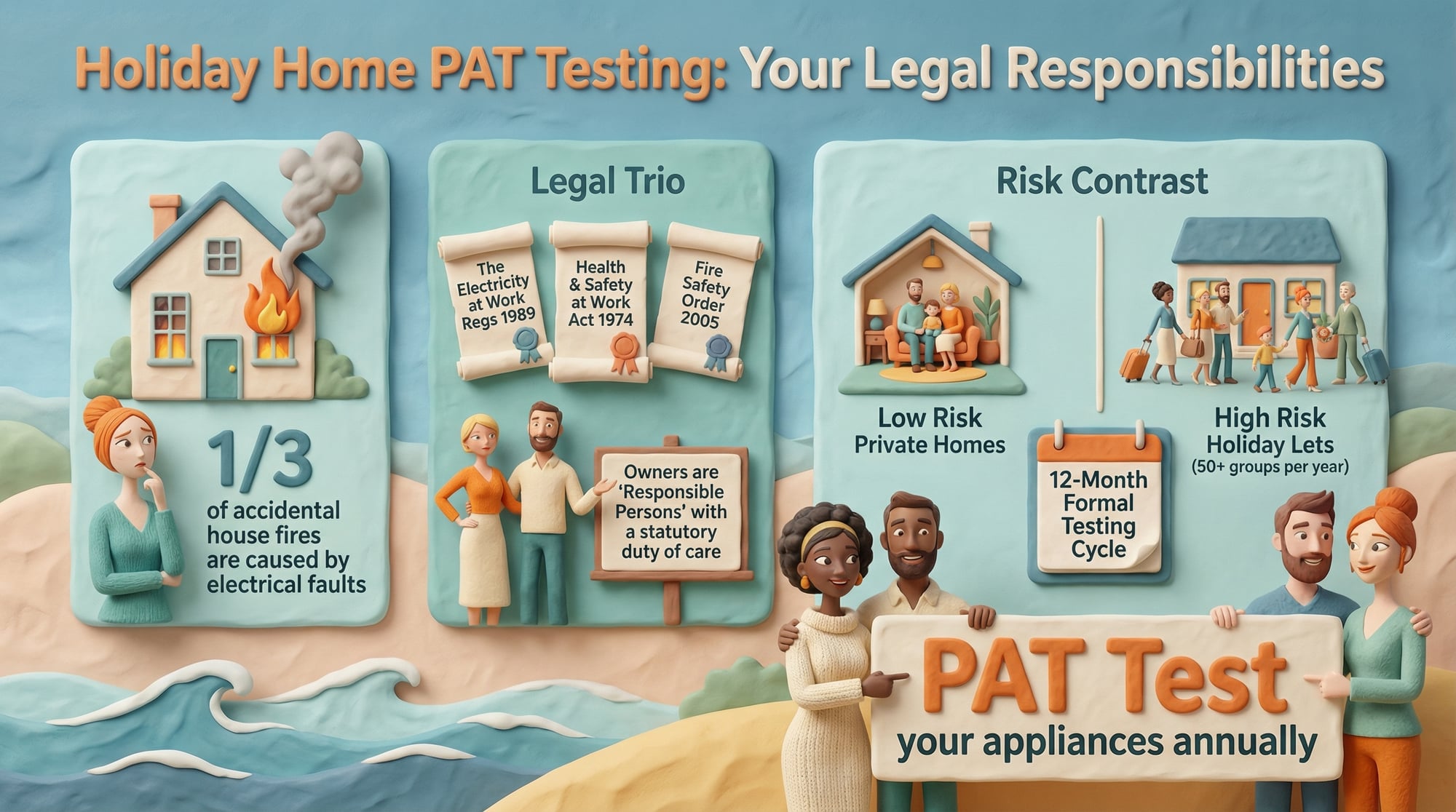
In 2024, around a third of all accidental house fires in England were caused by electrical faults or appliances. For Brighton holiday let owners, managing high guest turnovers means our appliances work harder than most.
While there isn't a specific "PAT Testing Act" that explicitly commands you to test every toaster every 12 months, the legal framework makes it a practical necessity. Ignoring it is a gamble that rarely pays off.
The Legal Reality for Brighton Hosts
In England, Portable Appliance Testing (PAT) exists in a bit of a regulatory grey area. Unlike the Gas Safety (Installation and Use) Regulations 1998, which mandate an annual check, electrical testing schedules aren't pinned to a specific calendar date by a single law.
However, as a holiday let owner, you are operating a business. This shifts you under the umbrella of two significant pieces of legislation:
The Electricity at Work Regulations 1989: This statutory instrument requires that all electrical equipment with the potential to cause injury is maintained in a safe condition.
The Health and Safety at Work etc. Act 1974: You have a statutory duty of care to ensure guests and contractors, like your cleaners or maintenance team, are not exposed to health or safety risks.
On top of this, the Government's own fire safety guidance for paying-guest accommodation, A Guide to Making Your Small Paying-Guest-Accommodation Safe from Fire , specifically states that electrical appliances should be subject to regular checks to confirm they remain in safe working condition, and references the IET Code of Practice for In-Service Inspection and Testing of Electrical Equipment as the standard to follow.
If a guest is injured by a frayed lamp cord and you cannot produce maintenance records, you are professionally and legally vulnerable.
Why Holiday Lets Are "High Risk"
You likely don't PAT test your own hairdryer at home, but a holiday let is a different environment. A standard residential home might see one family using a kettle carefully for years. A Brighton holiday home might see 50 or more different groups a year.
Because of this unmonitored use by the public, the Health and Safety Executive (HSE) advocates for a risk-based approach. For the short-term let industry, the standard expectation is a formal inspection and test every 12 months.
Furthermore, the Regulatory Reform (Fire Safety) Order 2005 applies to any premises providing accommodation for paying guests. Under this Order, you are the "Responsible Person." This means you must carry out a fire risk assessment, identify electrical hazards, and take "reasonable measures" to mitigate them. Because guests are unfamiliar with your property's layout and equipment, the Home Office applies stricter standards than those for a private home.
The Insurance Condition
This is the point where legal theory meets your bank balance. Even if you're comfortable with a bit of regulatory nuance, your insurer likely isn't. Most specialist holiday let policies include a "condition precedent." This requires you to comply with all relevant safety best practices for the policy to remain valid.
Some specialist holiday let insurers include an annual PAT testing clause as a condition of cover, while others simply expect you to follow recognised safety best practice. If a fire starts due to a faulty dishwasher and you don't have a valid PAT certificate, your insurer could void your policy, leaving you to personally cover the rebuild costs and any liability claims.
What Actually Needs Testing?
"Portable" is a slightly misleading term. In the eyes of a safety inspector, almost anything with a plug requires checking.
Small Appliances: Kettles, toasters, irons, and hairdryers.
Movable Equipment: Floor lamps, portable heaters, and fans.
IT Equipment: TVs, Wi-Fi routers, and smart speakers.
Stationary Items: Fridges, washing machines, and dishwashers (if they plug into a standard socket).
Visual Checks: The First Line of Defence
While a formal test happens annually, the IET Code of Practice suggests that regular visual inspections are critical. These can be carried out by your changeover team during their routine cleaning of a flat in Hove or a cottage in the Lanes. They should look for:
The Plug: Is the casing cracked or are the pins bent?
The Cable: Are there any cuts, abrasions, or visible coloured internal insulation?
The Appliance: Are there burn marks, strange smells, or loose components?
If your team spots damage, don't attempt a DIY repair. Remove the item immediately and replace it.
The Bigger Fire Safety Picture
PAT testing is just one piece of your safety puzzle. The Government's fire risk assessment checklist specifically asks, "Are electrical appliances periodically inspected and tested?" This makes it clear that PAT testing is a core component of your formal assessment.
Your other electrical obligations include:
Fixed Wiring: Having your internal wiring inspected at least every five years by a qualified contractor (such as an NICEIC-certificated or ECA member).
Gas Safety: Ensuring all gas appliances are checked annually by a Gas Safe registered engineer.
Alarms: Installing carbon monoxide detectors wherever there is a gas or solid fuel-burning appliance.
Our Advice for Brighton Hosts
To protect your property, your guests, and your peace of mind, we advise treating annual PAT testing as a non-negotiable standard for all Brighton hosts.